
Showroom fit-out in Dubai: lighting, floors and brand standards
A showroom fit-out in Dubai is judged on something the customer rarely puts into words: how the product looks from the door. A red car that reads brown under the wrong lamps. A sofa whose fabric changes colour between the window and the back wall. A watch case with a bright hot spot in the glass. Buyers react to the result even when they cannot name the cause. Behind that sits the harder problem for the tenant. Most brands opening a showroom here arrive with a standards book from head office or the manufacturer, and a unit that was never designed with that book in mind. The lighting layout, the floor build-up and the approval route all have to be reconciled with the book before anyone orders material.
Start with the product, then draw the ceiling
A showroom is a room designed around the object being sold, and the object changes almost every technical decision.
A car showroom needs clear span between columns, a vehicle door wide enough to drive through, a floor that takes the weight of cars sitting on the same spot for months, and lighting that works on curved, glossy paint. A furniture showroom is a set of rooms: warmer light, fabric and timber that have to read true, and displays that get rearranged every season. Electronics and jewellery work at a smaller scale, with glass cases, high contrast and glare as the main enemy. Kitchen and bathroom showrooms add working displays, which means water, drainage and power inside the display joinery itself.
Get the product list and the display plan from the brand before the ceiling is drawn. The reflected ceiling plan is where most showroom mistakes are made, and it is very hard to change once the gypsum is up.
Showroom lighting: colour rendering, glare and the glass front
Colour rendering comes first. General office LED fittings are commonly around CRI 80. Showrooms usually specify CRI 90 or above, and the number worth asking about separately is R9, the saturated red value. The headline CRI figure is an average that leaves R9 out, so a fitting can score well and still make red paint, walnut and skin tones look dull. Ask the supplier for the full test report, not the catalogue line.
Consistency matters as much as the rating. Two batches of the same fitting can differ in colour temperature enough to show on a white wall, and the effect is worst when fittings from different suppliers sit side by side. Specify a tight colour tolerance (a 3-step MacAdam ellipse is a common showroom spec) and order each fitting type in one batch.
Cars bring their own problem. A car body behaves like a curved mirror and reflects every fitting above it. A grid of downlights shows up as rows of dots on the bonnet, while long linear runs or large diffuse panels read as clean lines along the body. That is why so many car brand manuals dictate the type of ceiling lighting over the display floor as well as the light level.
Dubai daylight is the other factor. Showrooms on Sheikh Zayed Road or in Al Quoz often have full-height glazing facing strong sun. At midday, accent lighting has to compete with daylight or it simply disappears. After dark the same glass turns into a mirror, and the customer standing outside sees your fittings reflected back over the product. The answer is a control system with separate day and night scenes, and fittings positioned with the glass reflections in mind. On a lounge we delivered on Sheikh Zayed Road, the lighting was designed as scenes, with circuits and dimming fixed before the ceiling closed. A glass-fronted showroom needs that same approach, built around daylight.
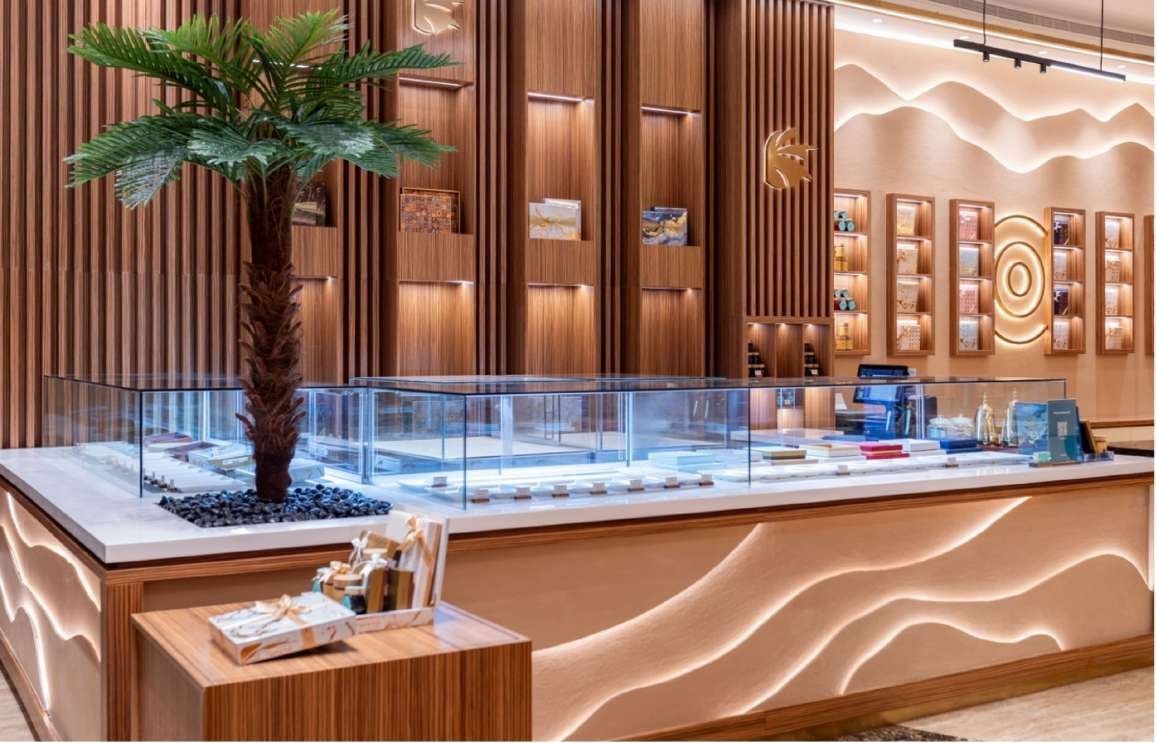
For merchandise that moves, track lighting pays for itself. On the Saudi Dates Centre at Dubai Hills Mall we set track, accent and case lighting to the merchandise rather than to a ceiling grid, with backlit product niches built into the joinery. One practical point from jobs like that: LED drivers usually fail long before the LEDs do. If a driver is sealed inside a display cabinet with no access panel, replacing it means taking the joinery apart.
Showroom flooring: what the floor has to carry
Start with load. A car on display puts its weight through four small contact patches and stays there for weeks. On a ground-floor slab that is rarely an issue. On an upper floor, a podium level or a new mezzanine display, a structural engineer has to check it, and the landlord will want that check before approving the layout.
Tyres are the next test. Cars driven in from a hot street can leave marks on some resin floors (the trade calls it hot tyre pick-up), and plasticisers in rubber can stain certain vinyls. Large-format porcelain is the usual answer in car showrooms, and some manufacturer manuals nominate the exact tile, size and grout colour.
Large tiles need a flat screed. Any lip between two tiles is exaggerated by low-angle light, and a showroom with a glass front gets exactly that light across the floor every afternoon. Write screed flatness into the specification, so it gets checked before tiling starts.
Natural marble reads as premium and suits jewellery, watches and high-end furniture. It also etches when acids reach it, including coffee and some cleaning products, and it needs sealing and periodic re-polishing.
Polished concrete depends entirely on the slab you inherit. Shell units in Dubai often arrive with patched cores and old service chases, and those show through once the slab is ground. Where the slab is poor, a resin or microcement overlay gives a similar look. Luxury vinyl tile is quick to lay and quieter underfoot, which suits furniture room sets and back-of-house areas, but it marks under heavy furniture legs.
Floor boxes are the detail that catches tenants out. Every island display that needs power or data needs a floor box positioned before the screed goes down. Adding one later means cutting the finished floor, and many Dubai buildings have post-tensioned slabs where coring without scanning risks cutting a tendon. Most landlords will not allow it without a structural engineer's approval.
Brand standards: reading the manual against the unit
A brand manual typically fixes the material palette, colours, fixtures, light levels and colour temperature, and the zones of the floor: display, consultation, vehicle handover, service reception, digital screens. Some manufacturers name the suppliers. Many ask to approve the layout in stages before the showroom opens.
The trouble is that many manuals are written for a standalone building, often in Europe, and the unit in Dubai is a tower podium, a mall box or a warehouse conversion in Al Quoz. Ceiling heights are lower than the manual assumes. The column grid cuts through the display floor. The landlord's signage rules limit the facade logo the brand wants.
Fire certification causes the most rework. A wall panel or ceiling finish nominated in the manual has to carry a fire certificate that Dubai Civil Defence accepts, for that exact product in that exact finish. Where it does not, the choice is a local equivalent with the right certificate, and that substitute then needs the brand's sign-off too. Finding that out after the material has shipped is expensive.
Keep one deviation schedule: every point where the unit cannot follow the manual, the reason, and the proposed alternative. Send it to the brand as a single package and get it approved before landlord submission. Sent one at a time, the same changes turn a single approval into months of back-and-forth.
Plan the back of the showroom as carefully as the front. On AD Tyres in Platinum Tower, JLT, the customer-facing front and the working space behind it were drawn to separate finish schedules, because one is specified for appearance and the other for durability under daily traffic. Showrooms with service reception or stock areas behind them need the same split.
Which authority approves a showroom fit-out in Dubai
Jurisdiction follows the land, not the business type. A showroom on Sheikh Zayed Road, in Al Quoz or in Deira is mainland Dubai, so Dubai Municipality handles the building permit and Dubai Civil Defence reviews fire and life safety. A design or furniture showroom in Dubai Design District goes through the Dubai Development Authority. Units in Jumeirah Lakes Towers go through DMCC together with building management, and Palm Jumeirah and Jebel Ali fall under Trakhees. We have set out the full map of Dubai fit-out authorities separately.
The landlord comes before any of them. The authority submission relies on the landlord's NOC, and in a mall the tenant coordination team reviews your drawings first, often more strictly than the authority does. Our guide to mall landlord rules for retail fit-out covers that stage in detail.
A few showroom items tend to trigger extra review. A new mezzanine is structural work and needs structural drawings in the submission. A raft or bulkhead ceiling over the display floor can move or block sprinkler heads and detectors, which brings Civil Defence into the drawing set. Vehicles displayed indoors raise questions about fuel and batteries, so ask the landlord and the fire reviewer how they want those handled before the layout is fixed. External signage usually carries its own permit, separate from the fit-out approval.
Programme: where showroom jobs lose weeks
Showrooms have one reviewer that other retail units do not: the brand. The sequence that holds is brand approval of the concept, then the landlord, then the authority. A brand change after the authority has approved the drawings can mean resubmitting them.
Imported finishes are the second risk. Nominated tiles, fixtures and lighting shipped from Europe or Asia add weeks that the programme has to carry from day one. Order long-lead items against approved drawings while the permit is in review, so procurement and approvals run side by side.
The third is lighting aiming. Accent lights can only be focused with the product in place, so cars or furniture need to be on site before handover, with a night set aside to aim the fittings and set the scenes. Leave that out and the showroom opens with lights pointed at empty floor.
For reference, our recent commercial units ran twelve weeks from shell to handover: 165 m² at Dubai Hills Mall in night working windows, and 150 m² in a working JLT tower. A larger showroom with imported materials and a brand approval loop will run to its own programme, and we would only commit to a date once the manual, the unit and the drawings have been read together. More on how we run retail fit-out in Dubai.
Questions this raises
What CRI should showroom lighting have?
CRI 90 or above is the usual showroom spec. Ask for the R9 value too, because the headline CRI figure leaves out saturated red, which is what makes red paint and timber look right.
What flooring works best for a car showroom in Dubai?
Large-format porcelain is the most common choice, and some manufacturer manuals nominate the exact tile. It resists tyre marks better than some resin and vinyl floors, provided the screed is flat. On upper floors or mezzanines, a structural engineer checks the vehicle loads first.
Can we use the materials our brand manual specifies?
Usually yes, provided each finish carries a fire certificate Dubai Civil Defence accepts for that exact product. Where it does not, you need a certified local equivalent and the brand's written approval of the substitute. Check the certificates before the order is placed.
Which authority approves a showroom fit-out in Dubai?
It depends on the land the unit stands on. Mainland locations such as Sheikh Zayed Road and Al Quoz go through Dubai Municipality and Dubai Civil Defence. Dubai Design District goes through the Dubai Development Authority, JLT through DMCC, and Palm Jumeirah and Jebel Ali through Trakhees.
How long does a showroom fit-out take?
It depends on size, the approval route and how much material is imported. Our recent commercial units of 150 to 165 m² took twelve weeks from shell to handover. A larger showroom with a brand approval loop and imported finishes takes longer. Send us the brand manual, the unit address and whatever drawings you have. We will read them side by side and tell you where they conflict before anything is priced. Start with our estimate form or WhatsApp +971 56 508 0888.
Send the drawings, or just the address.
We measure, check the services and tell you what the authority will require.
Other notes
Shopfit Interior LLC and Winteriors Decor LLC in Dubai
What is publicly on record about Shopfit Interior LLC and Winteriors Decor LLC in Dubai, and how to check any fit-out contractor, written by a competitor.
13 October 2026 · 12 min readShop fitting in Dubai: what the trade actually covers
Shop fitting in Dubai explained: where it splits from retail fit-out, what shopfitting companies build, and why joinery sets your opening date.
11 October 2026 · 12 min read
Shell and core, Cat A and Cat B: Dubai office fit-out terms explained
Shell and core, Cat A and Cat B explained for Dubai office tenants: what the landlord builds, what you pay for, and how the scope changes by zone and lease.
9 October 2026 · 11 min read