
Mall kiosk fit-out in Dubai: costs, landlord specs and approvals
A kiosk looks like the cheap way into a Dubai mall. Small box on a trading floor, no shopfront, no back of house, a rent line that reads as a fraction of an in-line shop. Then the fit-out manual arrives and the cost per square foot turns out higher than the shop you were priced out of. The reason is simple enough. Almost everything a shop needs, a kiosk needs too. Landlord NOC, authority approvals, fire detection tied into base build, graphics to the mall standard, an electrical supply the landlord has to agree to in writing, a contractor who holds passes for that building. None of that shrinks with the footprint. Spread across 8 square metres instead of 80, it lands hard.
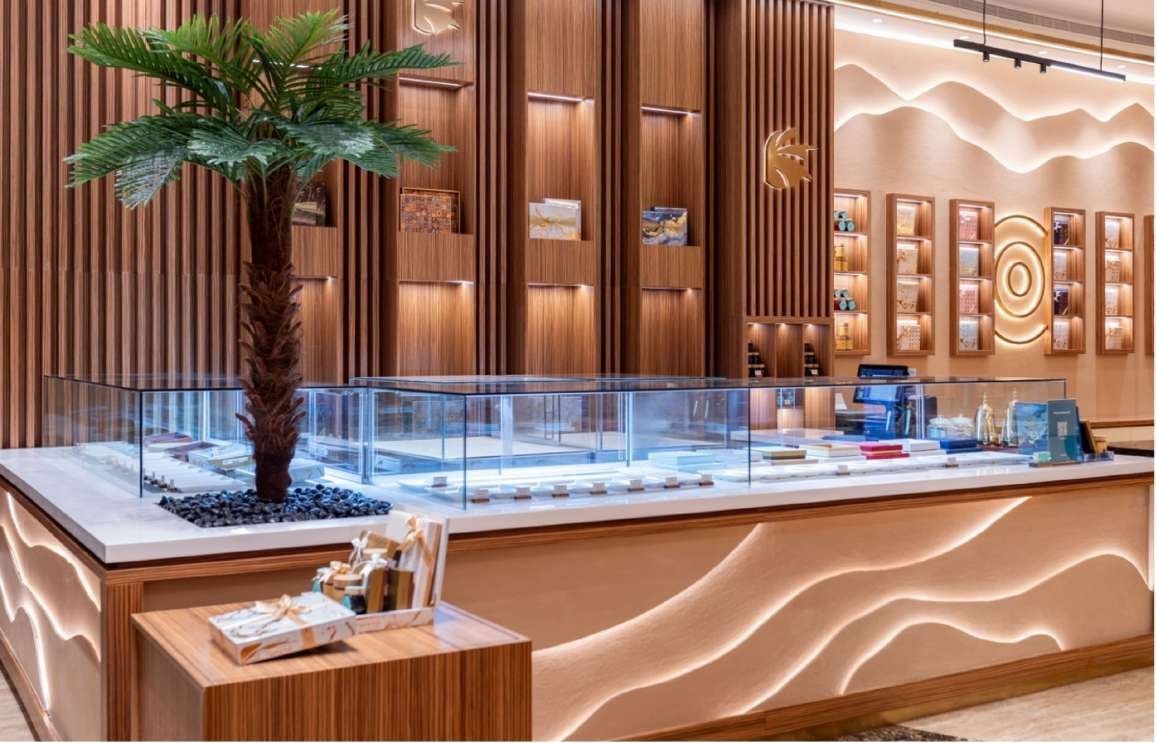
Mall kiosk sizes and the footprint you actually get
Most permanent kiosks in Dubai malls sit between 6 and 15 square metres. Under that you are into cart and trolley territory, usually leased on a promotional agreement rather than a fit-out lease. Above 15 to 20 square metres you are at an island unit, and the landlord starts treating it like a shop for approval purposes.
The leased area and the buildable area are different numbers. The manual sets a demise line, and anything that oversails it counts: a counter nosing, a canopy edge, a bag hook, a queue barrier. It also sets a maximum height, because the mall sells sightlines across the floor and protects the visibility of the in-line tenants behind you. That height limit is the single most-broken rule in kiosk design, and it is rarely the same number on every floor of the same mall.
Storage is the third constraint. There is no stockroom. Whatever you sell in a trading day lives under the counter, which means the joinery has to carry the merchandising, the stock and the staff circulation inside a footprint the size of a parking bay.
Mall kiosk cost in Dubai: what the first year actually holds
Reported market ranges for a kiosk build in Dubai run from roughly AED 20,000 for a simple retail unit to around AED 100,000 for one carrying refrigeration, integrated lighting and detailed joinery. Premium positions run higher again, and figures above AED 150,000 are reported for the top Dubai Mall locations. Published retail fit-out rates across the emirate sit in a band of roughly AED 350 to 1,800 per square foot. Kiosks land in the upper half of that band, for the reason above: the fixed items do not scale down.
Those are market figures published by others, not a rate card, and not a quotation. What a specific kiosk costs depends on the mall, the product and the equipment schedule. Our own numbers come after we have read your manual and your unit position, which is the shape of every retail fit-out we price.
First-year all-in budgets for a mall kiosk are commonly reported in the AED 180,000 to 450,000 range. Rent is the dominant line inside that, not the build. Sitting between the two there is a list most first-time tenants have not budgeted:
- A fit-out deposit held by the landlord and released against a clean handover, including the documentation
- A mall handling or supervision fee charged on the fit-out itself
- Contractor inductions, access cards and, in some centres, a per-night access charge
- Hoarding built to the mall's graphic standard, plus its removal
- Waste removal on the same night the waste is generated
- Contractor insurance naming the landlord
- Authority fees, which for a unit this size are typically in the low thousands of dirhams
Landlord specifications: Emaar, Majid Al Futtaim and Nakheel
Every major operator issues a fit-out manual with the lease, and the kiosk annex is usually a separate document from the shop annex. Emaar centres such as Dubai Mall and Dubai Hills Mall, Majid Al Futtaim centres such as Mall of the Emirates and City Centre Mirdif, and Nakheel centres such as Ibn Battuta Mall each run their own version. The clause families repeat; the numbers inside them do not.
Read for these before your designer starts:
We built the Saudi Dates Center at Dubai Hills Mall, a 165 square metre food retail unit in an Emaar centre. It is a shop, not a kiosk, but the manual is the same species of document and it drove the whole job: hoarding to the mall's graphic standard, contractor inductions before anyone went airside, booked service-lift slots, waste removed the same night, and no noisy work while the centre was trading. That pushed the build into night windows against a fixed opening date written into the lease.
On a kiosk those clauses bite harder, because the unit stands in open circulation with nothing to hide behind. Your hoarding is visible from three sides and the mall knows it.
- Maximum height, and whether anything at all may sit above it, including hanging signage and banners
- Flooring build-up, and whether you may fix into or core the finished mall floor
- Fire rating required on finishes, and whether certificates must cover upholstery and fabric as well as panels
- Signage: letter height, illumination type, which faces may carry the brand
- Any exhaust or venting, which in practice restricts what equipment is allowed at all
- How the unit must be secured when the mall is closed
- Working hours, and whether your trade is classed as noisy
Power, water and the MEP a kiosk is allowed to draw
The landlord allocates a supply to the unit in kW, and that allocation is a property decision rather than a design one. Retail kiosks commonly sit in a 10 to 20 kW band, and the spread inside that band is all about product.
A fashion or accessories kiosk runs lighting and a POS terminal, and rarely troubles the allocation. A coffee or juice kiosk runs an espresso machine, a grinder, two under-counter fridges, a water heater and a blender, and that schedule can consume the allocation before you have added a display chiller. Put an oven in the drawing and the number moves again.
When the equipment schedule exceeds the allocation, every option costs calendar time. Request an upgrade through the landlord, which can pull DEWA into the conversation depending on the building's spare capacity. Or re-specify the equipment, which usually means lower-draw machines and a menu conversation with the client. Finding this out at drawing stage costs a meeting. Finding it out after the joinery is built costs the joinery.
Water and drainage are decided by unit position, not by your preference. Many kiosk positions on a mall floor have power and data but no wet connection, and retrofitting one across a finished trading floor is rarely on the table. Extraction is stricter again. Mall kiosks are normally limited to equipment that produces no grease-laden vapour, because there is no duct route to a riser. Fire detection and any suppression have to tie into base build, which means a Civil Defence approved contractor working on the landlord's system, on the landlord's schedule.
Kiosk approval in a Dubai mall: DM, Civil Defence and Trakhees
The first question is not which forms to file. It is which authority governs the land your mall sits on, and we have set out the full map of Dubai fit-out authorities separately.
For mainland Dubai centres, including Dubai Mall, Dubai Hills Mall, Mall of the Emirates and City Centre Mirdif, the route runs through Dubai Municipality for the building permit and Dubai Civil Defence for the fire NOC. Every commercial premises inside a public building needs a valid DCD NOC, and a kiosk is not exempt because it is small.
Nakheel and wider PCFC developments are different. Ibn Battuta Mall, Dragon Mart and Nakheel Mall on Palm Jumeirah fall under Trakhees, the regulatory arm of Ports, Customs and Free Zone Corporation, which carries its own construction and EHS approval functions. A submission sent to Dubai Municipality for a Trakhees-governed unit gets returned, and you lose the days. This is the point most kiosk guides miss: Trakhees is a matter of where the mall is, not of what you sell.
Food adds a layer on top of whichever authority applies. You need a DET trade licence carrying a food activity, and if the kiosk is a new outlet under an existing licence, that means a branch licence for the new location. You also need a food establishment permit from the Dubai Municipality Food Safety Department, with a layout assessment approved before construction rather than after it. Your food safety lead needs Person in Charge certification, and every handler needs a valid Occupational Health Card.
The order matters. Landlord NOC comes first, because the authority submission leans on it. After that, technical review at Dubai Municipality is reported at 7 to 15 working days and Civil Defence at 5 to 10 working days, and those two can run alongside each other when the drawing set is genuinely complete on day one. Fees for a unit this size total a few thousand dirhams. Approvals cost you weeks far more than they cost you money.
Retail kiosk design in Dubai: what comes back marked up
Rejections cluster, and they cluster in the same places.
Height is first. A crown, a light box or a hanging ring that renders beautifully and breaks the sightline rule by 200 millimetres. Connected load is second: a schedule that quietly exceeds the allocation, which the landlord's engineer catches before the authority ever sees it. Signage is third, where the fault is usually letter height, illumination type or a logo placed on a face the manual reserves.
After that come material certificates. A fire certificate has to cover the actual product in the actual finish, against the standard the manual names, and it has to match the schedule line by line. A generic certificate for a similar board is a resubmission. Then the demise line, where an overhang or a bag rail crosses it. Then base-build coordination, where the drawing puts joinery under a sprinkler head or blocks a detector.
Each cycle is one to two weeks. Two cycles will eat the float you thought you had, which is why the height limit, the kW allocation and the signage clause deserve an hour of reading before the first sketch rather than after the first rejection.
From landlord NOC to trading: a programme with buffers in it
A realistic kiosk programme for a Dubai mall runs like this. Design and landlord review takes two to three weeks with one revision cycle assumed rather than hoped for. Authority submission and approval takes another two to three weeks, running Municipality or Trakhees alongside Civil Defence. Off-site manufacture of the joinery takes three to five weeks and can overlap the authority window once the landlord has stamped the drawings, at a commercial risk you should take with your eyes open. Installation itself is nights, and for a kiosk that is usually days rather than weeks. Then snagging, testing and the handover file.
The Saudi Dates Center job turned on exactly that overlap. Joinery was prefabricated off site and staged so each night's shift installed rather than manufactured, which is the only way a night-window build hits a fixed lease date. It handed over in February 2026, twelve weeks from start, with the handover documentation completed for the deposit release instead of chased afterwards. The full project record is here.
Seasonal against permanent: the money runs differently
A seasonal kiosk, typically 6 to 9 months, still needs the landlord NOC and still needs a fire NOC. What changes is the build and the exit. The unit has to be demountable, reinstatement of the mall floor is yours, and the deposit sits against that reinstatement rather than against a permanent handover.
The arithmetic changes more than the paperwork does. An AED 60,000 build amortised over nine trading months is a different cost per trading day than the same build over a three-year term, and turnover rent structures push the same way. A season is a cheap method of finding out whether a position actually trades before you commit capital to a fixed lease on it. Plenty of brands that now hold permanent units in Dubai malls started by renting a position for one Ramadan or one winter and reading the footfall themselves.
Budget the reinstatement on day one, in the same line as the build. It is the cost most seasonal tenants discover in month eight.
Questions this raises
How big is a typical mall kiosk in Dubai?
Permanent kiosks usually sit between 6 and 15 square metres. Carts and promotional trolleys run smaller and are normally leased on short promotional terms. Above roughly 20 square metres the landlord tends to treat the unit as an island shop, with a heavier approval route. Check the demise line in the manual before you size the joinery, because oversail counts against you.
What does a mall kiosk cost in Dubai in the first year?
Reported first-year all-in figures run in the region of AED 180,000 to 450,000, dominated by rent rather than by the build. The fit-out itself is commonly reported between AED 20,000 and 100,000, rising well past AED 150,000 in premium Dubai Mall positions. Those are market ranges published by others. A real number needs your mall, your unit position and your equipment schedule.
Which approvals does a kiosk in a Dubai mall need?
Landlord NOC first, then the authority that governs the mall. For mainland centres that is Dubai Municipality plus a Dubai Civil Defence NOC. For Nakheel and PCFC developments such as Ibn Battuta Mall or Nakheel Mall, it is Trakhees, which handles both sides in-house. Serving food adds a food establishment permit from Dubai Municipality Food Safety on top of whichever route applies.
Does a food kiosk need its own licence?
Yes, and licensing alone will not cover it. A trade licence from Dubai Economy and Tourism carrying a food activity, taken as a branch licence if the kiosk is a new outlet under an existing company, has to sit alongside a food establishment permit from the Municipality's Food Safety Department. The layout has to be assessed and approved before construction starts, your food safety lead needs PIC certification, and every handler needs an Occupational Health Card.
Is a kiosk actually cheaper than a small shop?
On rent, usually. On fit-out per square foot, usually not. The landlord NOC, the approval route, the fire tie-in, the graphics package and the contractor access costs are close to identical for both, so spreading them over 8 square metres gives a higher rate per square foot than spreading them over 80. Where the kiosk wins is total exposure and speed to trading.
Can we take a kiosk for one season only?
Many malls run seasonal and promotional positions for 6 to 9 month terms. The build has to be demountable, reinstatement is your obligation and cost, and the approval route can be lighter depending on the mall and the authority. It is a reasonable way to test footfall on a position before committing to a fixed term. Send us the fit-out manual and the unit position, and we will come back on what it allows, what it will cost to build and how the approval calendar runs. WhatsApp +971 56 508 0888.
Send the drawings, or just the address.
We measure, check the services and tell you what the authority will require.
Other notes
Coworking space fit-out in Dubai: zoning, acoustics, desk costs
Coworking space fit-out in Dubai: which authority approves it, how to zone a floor for noise, booths and meeting-room acoustics, and how to read cost per desk.
17 September 2026 · 10 min readLloyd Design Fitouts in Dubai: what the public record shows and who else to consider
What the public record shows about Lloyd Design Fitouts in Dubai, what it does not, and six vetted alternatives for your fit-out shortlist.
16 September 2026 · 11 min readJoinery fit-out companies in Dubai: how to judge the workshop
How joinery fit-out companies in Dubai differ: workshop capability, Civil Defence certificates, lead times, site survey discipline and snagging.
15 September 2026 · 12 min read