Joinery fit-out companies in Dubai: how to judge the workshop
Joinery is the part of a commercial fit-out your customers put their hands on. The reception counter, the display wall, the bar front, the cabinet under a clinic basin. It is also the package that fails latest and loudest, because it arrives near the end of the programme, when there is no time left to remake a panel. Search for joinery fit-out companies in Dubai and you get lists of names with the same adjectives attached to each one. None of that tells you what you actually need to know, which is where the work will be manufactured, who measured the site, and whether the finish on your wall panelling has a certificate the Civil Defence reviewer will accept.
What joinery covers in a commercial fit-out
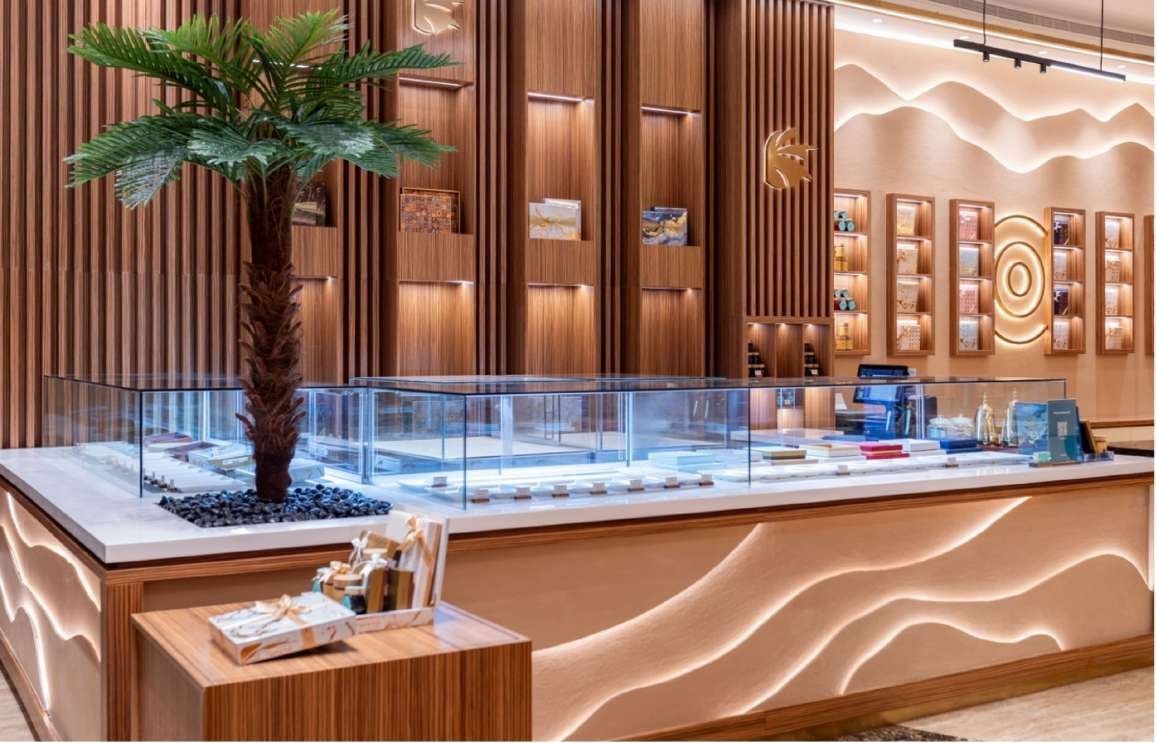
Joinery is everything built to fit your space rather than bought from a catalogue. In an office that means the reception desk, meeting room storage, the tea point, lockers, acoustic wall panelling and, in most towers, the door sets and frames. In retail it means the shopfront, display walls, the cash desk, fitting rooms and the back-of-house shelving nobody budgets for. In a restaurant it is the bar front and back-bar, banquette seating, waiter stations and the host desk. In a clinic or a salon it is casework: counters with non-porous tops, sealed junctions, and storage sized around equipment that has not been delivered yet.
What it is not: the stainless steel kitchen line in an F&B unit, which is a separate package with its own Food Control requirements, and loose furniture, which is procurement rather than manufacturing.
Joinery is also where a design gets tested for the first time. A rendering will not tell you that the counter top sits at 1,100 mm with the working surface behind it at 750 mm, that the plinth needs a 100 mm recess so staff can stand at it all day, or that the socket the AV consultant drew lands exactly where the drawer box goes. Those decisions happen once, in the shop drawings.
Joinery fit-out companies in Dubai: who actually makes the work
Ask any bidder one question early. Where will this be manufactured, and what is the address.
Some companies own a workshop and run their own production. Some are fit-out contractors who place the package with a workshop they have used for years, supervise it and carry the warranty. Some hold neither, and buy your joinery on the day of the order from whoever is cheapest that week. The first two can both work. The third is where clients meet a panel that does not match the sample and a supplier who has already been paid.
The answer you want is an address, a named contact and an offer to walk in during your production window. A company that will not name the workshop has usually not chosen it yet.
Responsibility matters more than ownership. If the joinery is late or wrong, you want one contractor holding the snag list, the remake and the defects period, rather than a main contractor pointing at a supplier who points at a shipping delay. The office we delivered for Solvu Solutions at Platinum Tower in JLT ran eight weeks end to end, which leaves no room for that argument.
Al Quoz, Sharjah or imported: where lead time comes from
Most commercial joinery in Dubai is made within a few kilometres of the same industrial roads. Al Quoz Industrial 3 and 4 hold the highest concentration of workshops, with more in Al Qusais, Ras Al Khor, DIP and across the border in the Sharjah industrial areas. Sharjah usually quotes lower and costs you drive time in supervision, plus tighter delivery windows into Dubai.
Working lead times, from the day shop drawings and the sample board are approved:
The clock starts on approved drawings, not on the contract. We have watched clients spend two weeks deciding between two oak finishes and then ask why the joinery is late. That fortnight came straight out of the production window.
Delivery access is the other half of the timeline. In a mall you deliver at night, through a service lift you booked in advance, under rules the tenant coordination team sets before your contractor is even appointed. Our unit for Saudi Dates Centre at Dubai Hills Mall ran twelve weeks, and the delivery slots shaped the sequence as much as the manufacturing did. The rest of that rulebook is covered in retail fit-out in a Dubai mall.
- Locally manufactured joinery for a commercial unit: typically three to six weeks, longer when the workshop is running several mall projects at once.
- Imported joinery from Europe or Asia: typically eight to twelve weeks before shipping, customs clearance and inland delivery.
- A remake of a damaged or rejected panel: days locally, and effectively impossible mid-programme on an imported package.
Materials that survive commercial traffic
Almost all commercial joinery here is an engineered board core with a face applied to it. The core carries the load and the face takes the abuse.
MDF is the standard core, usually 18 mm, and it machines cleanly for grooves, curves and profiles. It has no tolerance for standing water. Anywhere near a sink, a bar or a wash point, the spec should say moisture-resistant MDF, the green-core board, and the exposed edges should be sealed rather than left raw.
Plywood earns its place where things get screwed into or hung from. Behind plasterboard, an 18 mm plywood pattress at the fixing zone is what stops a loaded retail shelf pulling out of the wall two months after opening. Skipping it is a common false economy in shopfitting.
HPL is the workhorse face for commercial interiors. It is a thin pressed laminate bonded to the board, and it takes scratching, heat and cleaning chemicals better than anything else at its price. Reception fronts, retail shelving and back-of-house all live happily in it. Compact laminate, the thicker self-supporting version, is what you want for wet counters and cubicle systems where a board core would eventually swell.
Solid surface, the Corian family, is 12 mm, non-porous and thermoformable. Joints are bonded and sanded so the seam disappears, which is why it suits a curved reception counter, a clinic worktop or a bar top that gets wiped down a hundred times a day. It scuffs and it repairs with an abrasive pad, which no laminate does.
Veneer is a sliced sheet of real timber under half a millimetre thick, and it photographs best and ages worst if you put it in the wrong place. It moves with humidity and fades in direct sun through a tower window. Solid timber behaves the same way and arrives with a maintenance schedule attached.
The small print is where a specification holds up or falls over. Ask for 2 mm radiused edge banding on any surface people brush past, because 0.4 mm banding chips at the first trolley. Check shelf spans too: an 18 mm MDF shelf carrying retail stock over 900 mm sags visibly within a season, so it wants a thicker board, a plywood core or a mid support.
Joinery and Dubai Civil Defence
The fit-out drawings submitted to the authority that governs your address cover joinery too, rather than approving it as a standalone item. That authority is Dubai Municipality for most of the mainland, DDA in the TECOM and Business Bay districts, Trakhees for Palm Jumeirah and the Jebel Ali areas, and DMCC inside JLT. The fire strategy inside that submission goes to Dubai Civil Defence.
What the reviewer looks at in a joinery package:
On timing, a clean office fit-out submission typically comes back in around ten to fifteen working days. Retail and F&B units, which carry additional NOCs, more commonly sit in the fifteen to twenty-five working day range. Any reviewer comment resets that clock, which is why material certificates matter out of proportion to their cost: they are the cheapest item in the package and a routine cause of resubmission.
F&B carries a second layer. Food Control expects non-porous, cleanable surfaces with coved junctions in preparation areas, and no board-core joinery where water and food waste live. Clinics answer to DHA facility requirements, where casework has to be wipeable and hand-wash provision belongs in the layout rather than added later.
- Interior finish classification on wall and ceiling panelling, with stricter requirements inside escape routes and high-occupancy areas.
- Certificates of conformity for the boards, laminates and lacquers, issued for the actual product being installed rather than a similar one.
- Fire-rated door sets, complete with their certified frames, seals and hardware. Facing a certified fire door with an uncertified laminate voids the certificate it was bought for.
- Upholstery in F&B seating, where the foam and the fabric carry their own fire-retardant documentation alongside the frame.
- Whether the joinery blocks anything. A tall display unit under a sprinkler head or a cabinet run across a smoke detector is a comment you will get back.
The survey and the shop drawings decide the cost
Joinery gets measured on site, after the partitions and blockwork are up and the screed is down. Not from the lease drawing, and not from the architect's plan.
Buildings are not square. Across a four metre wall in a Dubai tower we routinely find ten to twenty millimetres of difference between one end and the other, plus a floor that falls towards a drain. Joinery made to a drawing dimension arrives with that error built in and the installer spends two days hiding it badly. Joinery made to a survey arrives with scribes and shadow gaps designed in, so the error disappears into a deliberate line.
The survey is also the coordination check: floor box positions before the screed goes down, sockets and data against the drawer layout, sprinkler drops against tall units, an AC grille that has to breathe through a bulkhead, drainage for a bar or a clinic basin. What you find at survey stage costs a phone call. The same thing found at installation costs a remake.
Then the shop drawings. Sections at 1:5, a hardware schedule with brands and models, a finish schedule with decor codes rather than colour names, and a client signature on all of it. That signature is what keeps the variation conversation short later, because the alternative is two people remembering a different oak. How we sequence survey, drawings and production against the rest of the programme is set out in our process.
Installation timing has its own rule. Veneered and lacquered joinery goes in once the air conditioning is running, temporary or permanent. Fitted into a hot, humid shell, panels take up moisture and doors stop closing properly about three weeks after handover.
What to look at on a factory visit
Go during your production window, not on a sales tour. The floor tells you more than the portfolio.
Ask the operational questions while you are standing there. Who employs the installation team, and what is the remake time if a panel is damaged in transit. Those answers predict how your last fortnight on site will go.
- Cutting: a panel saw or CNC beam saw, rather than sheets being hand cut with a track saw.
- Edging: a proper edge bander. Hand-applied edge banding on a commercial package will telegraph within months.
- Finishing: a dedicated spray booth with extraction, separated from the cutting area. Spray and sawdust in one room is what a dusty lacquer finish looks like at the source.
- Board storage: sheets stacked flat and off the floor, under cover, not leaning against a wall in a yard.
- A moisture meter somebody actually uses, and a dry assembly area where units go together before they are finished.
- How much of the floor is your job. A workshop with your panels cut and stacked is on programme. One that shows you somebody else's counter is not.
Snagging joinery, and the warranty that follows
Snag the joinery under the final lighting, before the site clean and before furniture arrives. Lighting changes what you see, and once a room is furnished nobody gets behind a unit again.
What goes on the list: gap and shadow lines consistent along their length, doors and drawer fronts aligned across a run, soft-close hardware actually closing, laminate and veneer batch matched across adjacent panels, edge banding intact at corners, silicone cut clean at wet junctions, no exposed fixings, plinths scribed to the floor rather than packed with offcuts, shelves and drawers loaded to test deflection and runners, and a sealed edge at the back of every wet-area cabinet.
The defects liability period on commercial fit-out here is usually twelve months from handover. Retail and hospitality work is frequently pushed to twenty-four, sometimes only against named elements such as joinery finishes or a shopfront, and the landlord's fit-out manual often sets that before a contractor is appointed. The warranty covers defective workmanship and defective materials. It stops at water reaching a cabinet from someone else's plumbing, client-supplied items, and a laminate worn through by the wrong cleaning chemical.
At handover, ask for the material certificates, the hardware brands and models, and leftover laminate offcuts with the touch-up kit. In two years, when a trolley hits a corner, that box decides between a repair and a new run.
What actually moves a joinery budget
We do not publish a rate per metre, and any company that hands you one before a survey is quoting a different job from the one you are about to build. What is worth understanding is which levers move the number.
Linear metres and height come first, because a run of full-height units carries far more material and labour than the same length at counter height. Then the face material and the finish, where a lacquered or veneered surface costs multiples of a laminate one and demands a cleaner workshop. Hardware is a real line rather than a detail: hinges and drawer runners are rated by cycles and dynamic load, and cheap ones fail inside the warranty period. Complexity drives hours, so curves, mitred edges, thermoformed solid surface and integrated lighting all cost more than flat work. Tight access adds labour, and a compressed programme adds night shifts.
The largest avoidable cost is timing. The same extra cabinet is cheap during design, expensive once the shop drawings are signed, and painful after the workshop has cut sheets from your material order. Read the exclusions page in a joinery quotation before you read the rate: appliances, stone tops, mirrors, glass, feature lighting and site protection are the items most often sitting outside a low headline number. If you are pricing an office fit-out, ask each bidder for joinery as a separate schedule with quantities, so you are comparing the same work rather than the same word.
Questions this raises
How much does commercial joinery cost per square metre in Dubai?
There is no honest single rate, and we do not publish one. Joinery is priced against linear metres, height, the face material, the hardware and the complexity of the shapes, so a straight run of laminate storage and a curved veneered reception counter can differ several times over across the same floor area. What you can ask for is a price against a defined specification: a layout, named materials with decor codes, a hardware schedule and a written exclusions list.
What is the difference between MDF and HPL for commercial joinery?
MDF and HPL are two parts of the same panel, not alternatives to each other. MDF is the core board, usually 18 mm, and HPL is the pressed laminate face bonded to it. A commercial specification will normally read as an MDF or plywood core with an HPL face, and near water it should read moisture-resistant MDF with sealed edges. Where water is constant, such as a wet counter or a cubicle, compact laminate replaces the core and face entirely because it is self-supporting and will not swell.
How long does joinery manufacturing and installation take in Dubai?
Locally manufactured commercial joinery typically runs three to six weeks in production from the day shop drawings and samples are approved, with installation adding days to a couple of weeks depending on the volume. Imported joinery typically takes eight to twelve weeks before it even ships. Quality tracks the workshop rather than the postcode, so an Al Quoz workshop with a beam saw, an edge bander and a proper spray booth will beat an imported package that arrives with two damaged panels and no realistic way to replace them.
Do I need Civil Defence approval for joinery in my fit-out?
Joinery is not submitted on its own. It is reviewed inside the fit-out drawings that go to your authority, and the fire strategy within that package goes to Dubai Civil Defence. What they check is interior finish classification on panelling, the certificates for the specific boards, laminates and lacquers being installed, certified fire-rated door sets, fire-retardant documentation for F&B upholstery, and whether any unit obstructs a sprinkler head or a detector. Missing certificates are one of the most common reasons a submission comes back, and every comment resets the review clock.
What warranty do I get on commercial joinery in Dubai?
Twelve months from handover is the normal defects liability period on commercial fit-out work, and retail and hospitality projects are often held to twenty-four, either across the works or against named elements such as joinery finishes and shopfronts. The landlord's fit-out manual usually decides which. Cover extends to defective workmanship and defective materials, and stops at misuse, damage caused by other trades brought in later, water reaching the joinery from another party's plumbing, and items the client supplied. Send the drawings or just the unit address to +971 56 508 0888 and we will come back with a joinery scope, a survey date and a production window that fits the rest of the programme.
Send the drawings, or just the address.
We measure, check the services and tell you what the authority will require.
Other notes
Joinery companies in Dubai: own factory or subcontractor
How joinery companies in Dubai split into factory owners and subcontracted packages, and what that changes for price, programme and approvals.
14 September 2026 · 11 min readJoinery companies in Al Quoz: factories, lead times and checks
Joinery companies in Al Quoz, Dubai: how to read a factory on a visit, realistic lead times for custom joinery, and the contract terms that decide who pays.
13 September 2026 · 12 min readHotel fit-out in Dubai: phasing work in an operating property
How a hotel fit-out in Dubai runs while the property keeps selling rooms: zoning, work fronts, dust and noise control, fire safety and the model room build.
12 September 2026 · 12 min read