
Joinery companies in Dubai: own factory or subcontractor
Search for joinery companies in Dubai and you get ranked lists. Ten best, seven top, twelve leading. None of them answer the question that decides your programme: does the company you are about to sign with actually manufacture the joinery, or does it buy the package from a workshop and add a margin? Both models deliver good work. They fail in different ways, they price differently, and they put the fire certificates and the remake liability in different hands. We build commercial units across Dubai and place a joinery package on nearly every one of them, so the choice sits on our desk as often as it sits on a client's.
What a joinery package covers in a commercial fit-out
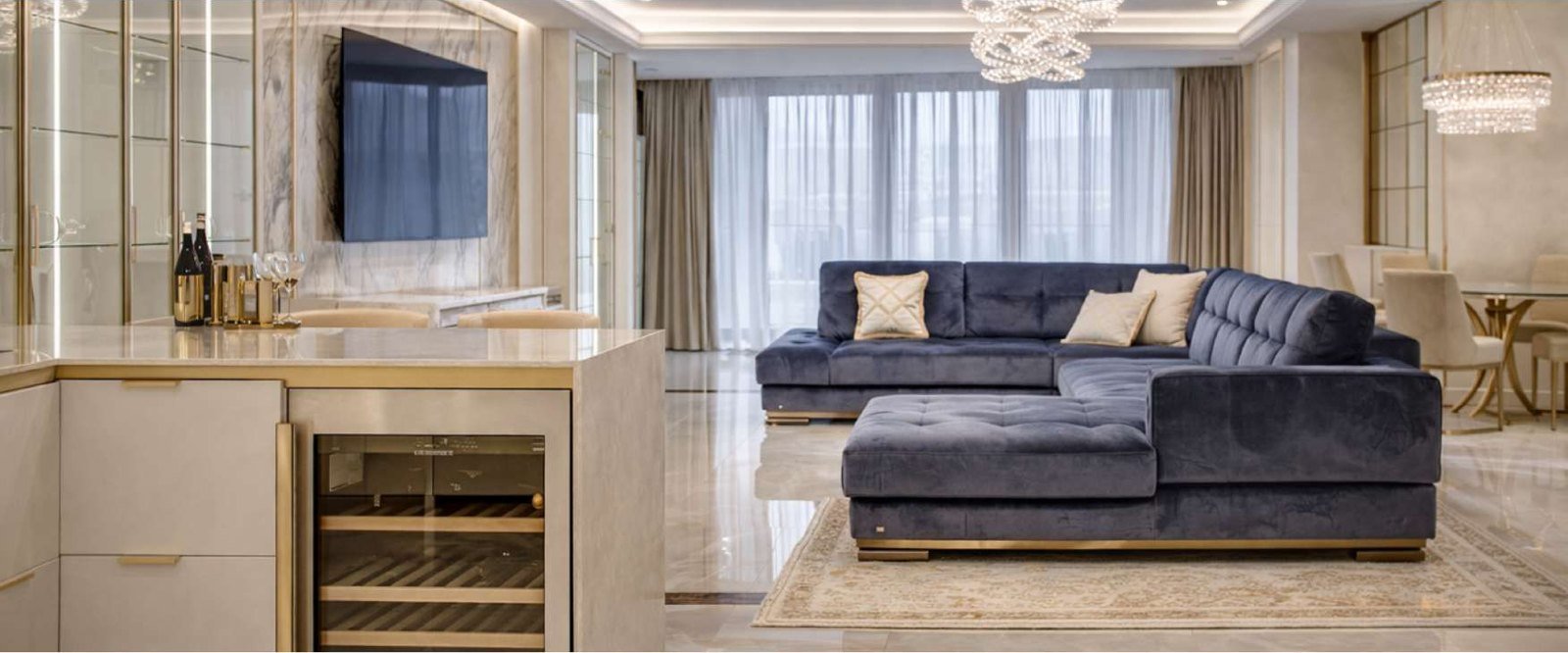
Joinery is the manufactured part of your interior. It is made off site, to your drawings, at dimensions taken from your actual walls: reception counters, storage walls, meeting credenzas, retail cash desks and display gondolas, bar fronts, clinic casework, salon stations, wall panelling, doors and frames.
Carpentry is what happens on site with a saw and a level. Framing, blocking, second fix, trimming a door that binds. The two words get used as if they mean the same thing, and the confusion costs money at tender stage, because a carpentry rate is priced by labour while a joinery package is priced as manufacturing with its own drawings, samples, approvals and delivery programme.
That distinction matters for one practical reason. After MEP equipment, joinery is usually the longest lead item on a commercial fit-out, and it is the trade most likely to be the reason a handover slips by two weeks.
Joinery companies in Dubai: factory owner or package buyer
A company that owns its production has money sunk into a beam saw, an edge bander, a CNC router, a spray booth with proper extraction, and an industrial unit with rent to pay every month. That payroll eats whether or not there is work on the bench. The upside for you is control: the production manager answers to the same director as the site foreman, and when a panel comes out wrong there is no negotiation about who remakes it.
The downside is queue politics. Your seventy metres of office storage sits behind somebody's hotel contract, and you find out on week three.
A fit-out contractor without a workshop places the package with a manufacturer it has used for years. No capex, no idle payroll, and the freedom to send veneer work to the shop that sprays well and laminate work to the shop that is quick. You pay a coordination margin for that. Nobody publishes the number and you should not trust anyone who quotes it as a rule, but the band that gets talked about around the trade sits somewhere in the mid-teens to mid-twenties per cent.
The third group holds neither a workshop nor a relationship. They buy your joinery on the day of the order from whoever is cheapest that week, and the first sign of it is a veneer panel that does not match the sample you signed.
The website will not tell you which one you are dealing with. The trade licence will. Manufacturing sits under its own activity line, and a company that genuinely runs production carries it. Ask for the licence copy and the unit address, in that order, and ask both of everyone you shortlist so nobody takes it personally.
What the second margin buys, and when you pay it for nothing
Going direct to a workshop removes a layer of cost. It also moves a set of jobs onto whoever is left holding them, which is usually you.
Somebody has to survey the walls after the blockwork is up and the plaster is on, because the drawing dimension and the built dimension are never the same. Somebody has to coordinate the socket that lands inside the reception desk with the electrical contractor, agree the finish schedule with the consultant, chase the sample approval, book the delivery slot, receive the units, check them against the schedule, raise the snags and hold a single warranty afterwards.
When a contractor's margin covers that work, it is fair money. When the contractor forwards your emails to the workshop and adds a percentage, you are paying for a mail server. The difference is visible in the first two weeks: a real package holder turns up with a survey, a set of shop drawings and a sample board, and asks you to sign the finish codes rather than the colour names.
The other half of the argument only shows up later. Buy direct and the workshop's liability generally ends at the delivery note. Buy through a contractor and the joinery sits inside the same defects period as the rest of your office fit-out, which means one snag list, one number to call and one company that cannot point at somebody else.
Where the factory sits, and why the address shows up in a remake
Production for Dubai commercial work clusters in a handful of industrial pockets: Al Quoz, Ras Al Khor, Al Qusais, Dubai Investments Park and Dubai Industrial City, plus the Sharjah industrial areas where rent is cheaper and unit prices often follow.
Distance is irrelevant until something goes wrong, and then it is the only thing that matters. A wrong panel from Al Quoz can be measured in the morning and back on site the same week. The same mistake in a Sharjah workshop adds a truck movement, an emirate border and a morning of someone's time. Imported joinery turns a remake into a shipping conversation, and there is no version of that conversation that ends inside your programme.
Mall projects add their own geography. Deliveries run through a booked loading bay in a night window, the service lift has fixed internal dimensions, and units that do not fit the lift have to be made in sections. The Saudi Dates Centre unit at Dubai Hills Mall took twelve weeks end to end, and most of that time was landlord logistics rather than manufacturing: booking the bay, fitting through the lift, and waiting for the next available night slot when a delivery slipped.
What moves a joinery price more than square footage
Joinery is not priced by area. It is priced by linear metre, by height, by the face material, by the hardware, and by how many shapes are not straight. A run of laminate storage and a curved veneered reception counter can differ several times over across the same floor area, which is why cost per square foot is close to useless as a way of comparing two joinery quotes.
We do not publish a rate, because an honest one does not exist. What you can insist on is a priced schedule item by item: this counter, this run of storage, these twelve doorsets. One line reading "joinery package" is not a quotation, it is a hostage note, and it makes every variation later a negotiation from zero.
The quiet cost drivers are worth knowing before you draw anything. Thermoformed joints in solid surface, mitred edge details, finished backs on units that will never be seen, a specified ironmongery brand, and any fire rating all move the number more than clients expect. So does colour consistency, because matching a veneer across twelve panels means buying from one log and paying for the privilege.
Production time starts when the drawings are approved
Locally manufactured commercial joinery typically runs three to six weeks in production, counted from the day shop drawings and samples are approved. Longer when the workshop is carrying several mall projects at once. Imported joinery from Europe or Asia typically takes eight to twelve weeks before it even ships, and then customs and inland delivery sit on top.
The clock does not start when you sign the contract. We have watched a client spend two weeks choosing between two oak finishes and then ask why the joinery was late. That fortnight came straight out of the production window, and there is nowhere else for it to come from.
A subcontracted package normally adds a little time at the front, because the survey, the drawings and the sample round trip through one more office. On a well run job that is days. On a badly run one it is the difference between installing joinery into a finished shell and installing it while the painters are still there.
Eight weeks was the whole programme for the office we built for Solvu Solutions at Platinum Tower in JLT, and that number only held because the joinery went into production while the ceilings were still going in. How we sequence survey, drawings and production against the rest of the programme is set out in our process.
Fire rating, material approvals and the signature on the shop drawings
Commercial joinery carries compliance that domestic work never touches, and this is where the difference between a workshop and a broker becomes expensive.
Fire-rated doorsets are certified as an assembly. The leaf, the frame, the intumescent seals and the ironmongery are tested together, and the rating you specify, commonly 60, 90 or 120 minutes depending on where the door sits, belongs to that combination. Swap the closer for a cheaper one on site and the certificate no longer describes what is hanging in your wall. Dubai Civil Defence will ask for the certificate, not for a photograph of the door.
Wall panelling and linings in escape routes have to meet the surface burning class set by the UAE Fire and Life Safety Code, tested to ASTM E84 or an equivalent standard. That certificate belongs to the material and its batch, so a workshop that swaps board suppliers mid-project has broken the paperwork even if the panel looks identical.
Shop drawings are the other signature. The consultant stamps them, the landlord or mall management approves the finishes against the fit-out manual, and the authority that governs your building signs the permit package. Which authority that is depends on the address rather than the trade, and we set the map out in which authority signs off a Dubai fit-out.
Plan on a shop drawing approval cycle of roughly two to four weeks for a straightforward commercial unit. Push that out when a fire certificate has to be produced for a material nobody on the project has used before, because the workshop then has to source certified stock rather than the board it keeps on the rack. A supplier who has never assembled a rated doorset will quote one happily and discover the certification problem in week five.
Office, retail, F&B and clinic joinery are not the same order
An office package is mostly storage walls, reception and meeting room credenzas, in laminate or veneer, with the coordination effort going into services: sockets, data, and the gap behind a unit where a fan coil needs air.
Retail inside a mall is dictated by the fit-out manual before it is dictated by taste. Materials, edge protection, shopfront line, delivery windows and the height of anything visible from the mall corridor are all written down by the landlord's team, and a workshop that has not read that document will build you something that gets rejected at handover inspection.
Food and beverage is the harshest environment joinery ever lives in. Bar fronts get hosed, counters get chemical cleaners twice a day, and anything near a wash-up area is in permanent humidity. Solid surface tops, sealed edges and stainless where the public cannot see it are the pattern that survives. The bar joinery also has to give way to extraction routes and gas lines, which is why on the restaurant work we delivered on Sheikh Zayed Road for Gashisha and Dr Sheesha the kitchen and bar drawings were coordinated as one set rather than two.
Clinics answer to the Dubai Health Authority as well as to the building's authority. Wipe-clean surfaces, sealed joints, no exposed raw timber in clinical areas, hand-wash basins boxed in a way that can actually be cleaned. Salons and spas sit between the two, with joinery that has plumbing running through it and a wet zone underneath.
Questions that expose the delivery model before you sign
Ask all of these of everyone on your shortlist, in writing, and compare the answers rather than the brochures.
A company that manufactures answers the first three without checking with anyone. A company that places packages answers them by naming its workshop, which is a perfectly good answer. A company that stalls on all three is the reason this article exists.
If you have drawings, or just a unit address and a rough idea of what you need built, send them to +971 56 508 0888 and we will come back with a joinery scope, a survey date and a production window that fits the rest of the programme.
- Which trade licence activity covers the manufacturing, and is it your licence or someone else's?
- What is the unit number and address of the workshop, and can we walk it while our items are on the bench?
- Who signs the shop drawings, and who holds the fire certificates for the rated items?
- Is the joinery priced item by item, or as a single line?
- If a panel arrives wrong, who remakes it, who pays for the second delivery, and how many days does it take?
- Which items are imported, and what is the ship date sitting behind them?
- Who carries the defects liability for the joinery after handover, and for how long?
Questions this raises
Does a joinery company need its own factory to do good work?
No. Ownership decides who controls the queue, not who controls the quality. Plenty of strong commercial joinery in Dubai comes out of workshops that build for contractors rather than selling direct. What matters is that one named company holds the drawings, the certificates, the snag list and the warranty, and that you can find out which workshop is cutting your material before the order is placed.
How long does joinery production take in Dubai?
Locally made commercial joinery typically runs three to six weeks in production from the day shop drawings and samples are approved, with installation adding anything from a few days to a couple of weeks depending on volume. Imported joinery typically needs eight to twelve weeks before it ships. Neither clock starts at contract signature, which is the single most common misunderstanding on a fit-out programme.
Do I need fire-rated joinery in a commercial unit?
Wherever the fire strategy says so, which usually means doors onto escape corridors, doors into risk rooms, and any panelling inside a protected route. The rating is a property of the whole assembly rather than the door leaf, so leaf, frame, seals and ironmongery all have to match the tested set. Dubai Civil Defence asks for the certificate at inspection, and a substituted hinge is enough to invalidate it.
Can a joinery company handle shop drawings and consultant approvals?
Some can and some quietly cannot. Producing manufacturing drawings is not the same skill as producing a submission a consultant will stamp and an authority will accept, and a workshop geared to furniture output often has neither the drafting team nor the approvals experience. Ask to see a shop drawing set from a completed commercial project before you assume it is covered.
Is buying joinery directly from a workshop cheaper?
The unit price usually is. The total often is not, once you count the survey, the coordination with the electrical and mechanical trades, the sample approvals, the delivery bookings and the remakes. Direct purchase also leaves you holding the defect risk, because most workshops end their responsibility at the delivery note rather than at the end of your defects liability period.
Send the drawings, or just the address.
We measure, check the services and tell you what the authority will require.
Other notes
Modern office fitout in Dubai: the zones hybrid teams actually use
Which zones in a Dubai office fitout stay busy, which sit empty, and how hybrid zoning changes area per seat, MEP load, acoustics and the budget split.
29 October 2026 · 13 min readServer room in a Dubai office fit-out: cooling and approvals
How a server room is built inside a Dubai office fit-out: precision cooling, heat load, clean agent suppression, dedicated power and who approves what.
27 October 2026 · 15 min readRunning a fit-out tender in Dubai: scope, visits, levelling
How to run a fit-out tender in Dubai: what goes in the tender pack, how to run site visits, freeze scope and level bids so prices are actually comparable.
25 October 2026 · 14 min read