Cafe fit-out in Dubai: cost, approvals and how long it takes
A cafe fit-out in Dubai sits at reported market rates of roughly AED 400 to 800 per square foot for a standard build, against AED 700 to 1,200 for casual dining and AED 1,200 upwards for fine dining. Those are bands circulating in the market rather than our rate card, and the distance between them is not the furniture or the lighting. It is the kitchen. That single fact decides most of what follows. A coffee shop with an espresso machine, a fridge under the counter and a panini grill is a different building job from a restaurant with a fryer bank and a gas line, and the approvals chain treats it differently too. The problem is that almost every cost guide for Dubai lumps the two together under "F&B", quotes one wide range, and leaves the operator to guess which end of it they are on.
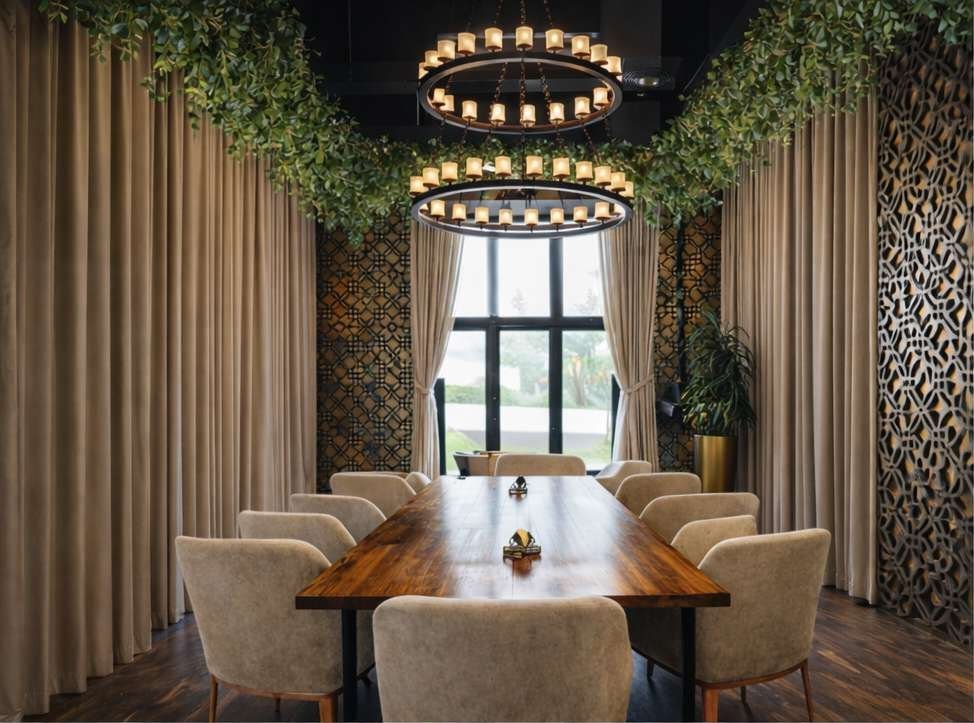
What a cafe fit-out costs in Dubai
The per-square-foot numbers above cover construction, MEP and joinery. Equipment sits outside them. Coffee equipment, refrigeration, POS and small wares are a separate line and they are not small: a two-group machine, grinders, water treatment and under-counter refrigeration will comfortably absorb a six-figure sum on their own.
For turnkey cafe fit-out totals, published figures for a kiosk format of 15 to 30 square metres cluster around AED 150,000 to 385,000 including design, permits, construction, furniture, equipment and a contingency. Inline cafes of 300 to 600 square feet are commonly quoted several times higher. Treat all of those as orientation figures. The spread inside them is driven by things nobody can price from a floor area.
Shell condition is the largest of those. A unit that previously traded as F&B may come with a drainage route, a grease interceptor, an extraction riser and a water point already in place, and that can move a budget by tens of thousands. A bare shell in a tower where the nearest drain is thirty metres away is a different project with the same square footage.
The second is the counter. On a cafe fit-out, the counter is the whole building programme condensed into one piece of joinery: it carries water in, waste out, three or four separate power feeds, a chilled section, and the machine that defines the customer's first impression. It is also the item most often drawn before the equipment is chosen. When the machine arrives 40 mm wider than the cutout, or the grinder needs a socket the joinery has no space for, the counter comes apart on site during the final week. Freeze equipment models and their service clearances before the joinery drawings go for production, not after.
Back of house is where cafe fit-outs are underpriced most often. Operators budget the seating area in detail and leave a round number for "the back", then discover that the storage, the staff changing provision, the cleaning materials store and the wash-up all have to exist as separate, finished, inspectable spaces. If you want that scoped honestly before you sign a lease, send us the unit plan through our estimate page.
Where a cafe is genuinely simpler than a restaurant
The licence is the first fork in a cafe fit-out. Mainland operators apply to Dubai Economy and Tourism, and a full restaurant activity is commonly cited as 561010 while a cafeteria sits at 561019. There is a separate coffee shop activity as well. The code follows the menu rather than the branding, and it is worth settling early, because the food permit, the kitchen requirement and in some cases the landlord's own tenancy conditions follow from it. Reported figures for the DET licence itself run around AED 18,000 to 25,000, with first-year licensing and approvals more often quoted between AED 20,000 and 32,000 once trade name reservation, initial approval and market fee are added.
The kitchen is the second fork and the expensive one. A restaurant kitchen is designed backwards from the menu: extraction volume comes from the appliances under the canopy, make-up air has to replace what the canopy pulls out, the duct needs cleaning access along its whole route, and gas brings interlocked suppression with it. A cafe that never lights a burner skips almost all of that. No solid fuel, no fryer, no gas bank, no suppression system wired to a shut-off valve.
That is the honest boundary of this article. If your menu has a fryer, a grill, a wok or a tandoor on it, you are building a restaurant kitchen regardless of what the sign outside says, and the mechanics of that build are covered separately in our piece on restaurant kitchen extraction, gas and food control and on our restaurant fit-out page. Reading a cafe guide and applying it to a hot kitchen is how opening dates get lost.
What does not change is the approvals chain itself. A cafe still goes to Dubai Municipality food safety, still goes to Civil Defence, still needs the landlord's fit-out approval, still needs Ejari and DEWA. The scope inside each of those is smaller. The number of doors is identical.
The grease trap question, because it always comes first
The most common claim we hear from cafe operators is that a coffee shop does not need a grease trap. That is not what the regulation says. Local Order No. 8 of 2002 requires the private sewerage network of a restaurant, cafeteria, food factory, fast food outlet, hotel or similar food establishment to pass through a grease trap meeting the competent department's specification before it discharges to the public sewer. A cafeteria is named in that list.
What changes for a cafe is the size, not the existence. Dubai Municipality's sizing method scores the sinks and fixtures, the kitchen type, the operating hours and the meals served per day, multiplies that against total faucet flow and a drain pipe score, and reads a minimum capacity off a table that runs from 60 litres up to 6,000 litres. A coffee shop lands at the bottom of that table. A grill house lands near the top. Both are on it.
There is a practical reason not to fight this. Milk is the problem, not oil. Steamed milk residue, milk foam and coffee grounds go down a small trap continuously through the day, emulsify, and coat the baffles as a soft sludge that sets. A 60 litre trap under a busy espresso counter can start smelling in weeks if nobody has scheduled it. Dubai Municipality's minimum cleaning frequency for food establishments is at least twice a month, and on a cafe that minimum is a floor rather than a comfortable interval. Put the trap where a technician can reach it without lifting your finished floor. This is a decision made on the drawings and almost impossible to fix afterwards.
Dubai Municipality food safety approval for a cafe
The sequence matters more than the paperwork on a cafe fit-out, because one step gates the build. The kitchen layout goes to Dubai Municipality food safety for pre-approval before fit-out work starts. Building first and submitting afterwards is the single most expensive mistake in this category, and it is common, because tenants under rent pressure start demolition the week they get the keys.
What goes in typically covers the layout drawing showing the flow of food and staff, the fixture schedule, finishes for floors, walls and ceilings, the drainage and grease trap arrangement, ventilation, and the trade licence details or initial approval. The reviewer is checking that the plan physically prevents cross-contamination and that every surface in a food area can be cleaned. Handwash basins have to be separate from preparation sinks, and the taps have to be elbow, foot or sensor operated. Standard twist taps are a violation and they still turn up on finished counters every year. Walls in food handling areas are clad or tiled to at least two metres with smooth, non-absorbent, non-combustible material. Equipment sits on castors or on legs raising it at least 150 mm off the floor so the underside can be cleaned.
After the build there is an inspection of the finished premises, and the food permit follows that. A Person In Charge certified through an approved food safety training programme has to be in place. Book that training early. It is a small item that has delayed openings because nobody owned it.
One caution about timing. Every "DM approval in X weeks" figure circulating in Dubai comes from contractors and consultants, not from a Municipality service standard. We are not going to add another one. What we can say from running these submissions is that clean, complete drawings come back faster than incomplete ones by a wide margin, and that the resubmission cycle, not the first review, is what stretches the calendar.
Does a cafe need Civil Defence approval
Yes, and the size of the unit does not change that. There is no minimum area threshold for a Dubai Civil Defence NOC on commercial premises. A 50 square metre cafe fit-out goes through the same four-stage process as a large restaurant fit-out: drawing approval, installation, inspection, then the final fire safety certificate. The trade licence is not activated without it.
What differs is scope. Without gas and without a cooking canopy, there is no hood suppression system, no interlocked gas shut-off and no solid fuel arrangement to justify. The submission is closer to a retail fit-out with a food use: detection, emergency lighting, exit signage, sprinkler modification where the ceiling changes, and material fire ratings on the finishes. Kiosks in mall common areas carry their own conditions from the mall's fit-out manual on top of that.
DEWA, landlord NOC and Ejari
DEWA, the landlord NOC and Ejari run in the background, and the order between them surprises most operators. Ejari registration comes off the tenancy contract and costs AED 177.75 online through the Dubai REST app or DLD website, or around AED 220 in person at a trustee centre. DEWA then needs the Ejari number and the premises DEWA number to open the account. For commercial premises DEWA sets the deposit from expected consumption rather than a flat figure, so a cafe with refrigeration and an espresso machine will not pay what a small retail unit pays.
The landlord sits across all of it. Mall and tower landlords issue a fit-out manual and their own NOC, and that document usually controls working hours, contractor insurance, lift booking, hoarding, the permitted route for services, and a refundable fit-out deposit. On a cafe the landlord clause that bites most often is the one governing where waste and extraction can run. Confirm the drainage route and any available extraction riser before signing, not after. Our process page sets out how we sequence these against the build programme.
The minimum kitchen for a small cafe fit-out or a kiosk
A commonly quoted Municipality minimum for a coffee shop kitchen is around 150 square feet, with roughly another 100 square feet needed to make a seating area work commercially. Verify the current requirement against your specific activity code before you commit to a unit, because it varies by classification.
Whatever the number, the back of house has to physically contain the following, and each one takes floor space:
That water treatment line is worth dwelling on. Dubai's supply is desalinated, and its mineral profile is not what espresso equipment is calibrated around, so filtration and remineralisation live under the counter and need both a feed and a drain. Cafes that discover this after the counter is built end up with a filter housing in the customer's eyeline.
On extraction, a pure espresso and cold food operation may need general mechanical ventilation only. Add a panini grill, a convection oven or a rotisserie and you are back into canopy territory with a duct that has to terminate above the roofline of the surrounding building. The figure quoted by contractors is commonly around two metres above the nearest building, and the exact requirement should be confirmed against the current code for your specific unit rather than assumed from a blog.
- a wash-up sink arrangement, typically three compartments, separate from any preparation sink
- a dedicated hand wash basin with a non-twist tap, soap and paper dispensers
- cold storage sized for the menu, plus a dry goods store off the floor
- a cleaning materials store that is not the same cupboard as the food store
- staff changing and personal belongings provision
- the grease trap, sited for access
- water filtration and treatment for the coffee equipment, with a feed and a drain under the counter
- mechanical ventilation, with a canopy if any hot equipment is used
Where the weeks actually go
A realistic cafe fit-out programme is a design and approvals phase of roughly three to four weeks, a construction phase of six to ten weeks, and an approvals track that overlaps both rather than sitting neatly between them. Ten to eighteen weeks from signed lease to trading is a fair planning assumption for a straightforward unit. Restaurants are commonly quoted at eight to twenty weeks and the difference is almost entirely kitchen and gas.
What compresses that: a previous F&B shell with services in place, a frozen equipment schedule before joinery goes to production, and a complete first submission. What expands it is different: a landlord NOC that arrives late, plus a second Municipality review triggered by a drawing that did not show the drainage arrangement clearly. Long-lead joinery ordered after the site is otherwise finished stretches the programme further. The build is rarely the bottleneck on a cafe. The paper is.
If you have a cafe fit-out in mind and want the approvals path and the cost shape mapped against it before you commit, send us the plan and the address on +971 56 508 0888. Half an hour on a drawing is cheaper than a month of rent on a unit that cannot take a drain.
Questions this raises
How much does a cafe fit-out cost in Dubai per square foot?
Reported market bands put a standard cafe build at roughly AED 400 to 800 per square foot covering construction, MEP and joinery. Premium specification runs higher. Coffee equipment, refrigeration and POS sit outside that figure and are budgeted separately. These are market ranges rather than a quotation, and shell condition moves them more than area does.
How long does it take to get a cafe approved by Dubai Municipality?
Nobody publishes a service standard for this, and the week counts circulating online come from contractors rather than the Municipality. The layout pre-approval is the step that gates your build, so it goes in before demolition starts. In practice the resubmission cycle decides the calendar: complete drawings that show flow, finishes, drainage and ventilation clearly avoid a second round.
What is the difference between a cafe licence and a restaurant licence in Dubai?
The activity code differs, with a full restaurant commonly cited under 561010 and a cafeteria under 561019, and there is a separate coffee shop activity as well. The code follows the menu. The practical consequence is the kitchen requirement attached to it, which is far lighter without cooking, gas or solid fuel.
Do cafes need Civil Defence approval in Dubai?
Yes. There is no minimum size threshold, so a small cafe or a mall kiosk goes through the same four stages as a large venue: drawing approval, installation, inspection, and the final fire safety certificate. The trade licence is not activated without the NOC. The scope is smaller than a restaurant because there is no hood suppression or gas interlock to justify.
What are Dubai Municipality kitchen requirements for a small cafe?
Separate hand wash basins with elbow, foot or sensor operated taps, a multi-compartment wash-up sink apart from preparation sinks, smooth non-absorbent cladding to at least two metres in food handling areas, equipment on castors or raised at least 150 mm off the floor, sized cold and dry storage, a separate cleaning materials store, and a grease trap on the kitchen drainage.
Can I open a cafe without a gas line or a commercial oven in Dubai?
Yes, and it is the main reason a cafe is faster and cheaper to build than a restaurant. Without gas there is no cylinder bank or piped supply to approve, no interlocked shut-off, and no canopy suppression system. Keep it that way deliberately: adding one grill or oven later can pull you back into full extraction and Civil Defence scope.
What documents do I need for Dubai Municipality food safety approval?
Typically the trade licence or initial approval, the tenancy contract, and a layout drawing showing food and staff flow, fixtures, floor, wall and ceiling finishes, drainage and grease trap arrangement, and ventilation. A certified Person In Charge is required before the food permit is issued, and that training should be booked well ahead of the inspection.
Do I need a grease trap for a coffee shop in Dubai?
Yes. Local Order No. 8 of 2002 names cafeterias alongside restaurants and requires a compliant grease trap before discharge to the public sewer. What changes is capacity: the Municipality sizing method scores fixtures, kitchen type, hours and covers, and reads a minimum off a table starting at 60 litres. Milk residue and coffee grounds foul a small trap quickly, so plan for accessible servicing at least twice a month.
Send the drawings, or just the address.
We measure, check the services and tell you what the authority will require.
Other notes
Joinery companies in Al Quoz: factories, lead times and checks
Joinery companies in Al Quoz, Dubai: how to read a factory on a visit, realistic lead times for custom joinery, and the contract terms that decide who pays.
13 September 2026 · 12 min readHotel fit-out in Dubai: phasing work in an operating property
How a hotel fit-out in Dubai runs while the property keeps selling rooms: zoning, work fronts, dust and noise control, fire safety and the model room build.
12 September 2026 · 12 min readDental clinic fit-out in Dubai: chair services and shielding
What a dental surgery needs that a normal clinic room does not: core services under the chair before the screed, lead shielding signed off, and a plant room.
11 September 2026 · 13 min read